West Vancouver, BC

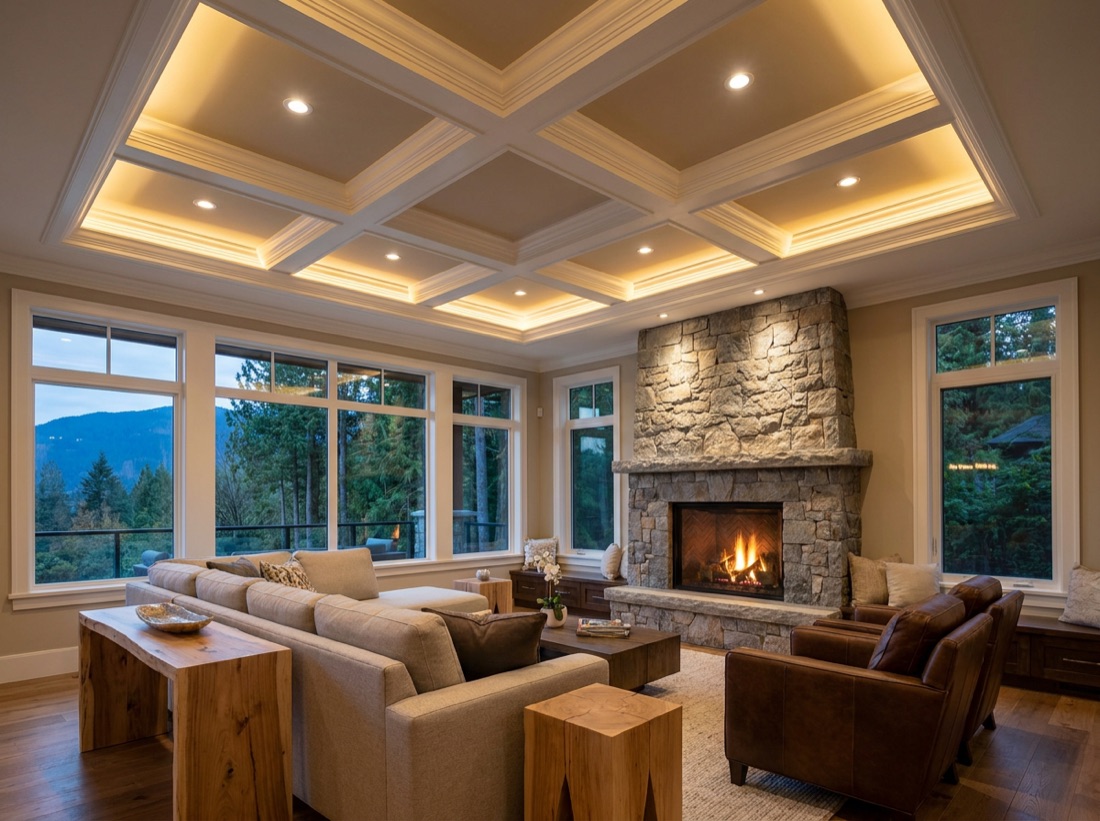
Crown moulding and ceiling lighting in West Vancouver.

West Vancouver rooms tend to have the two things a finished ceiling needs: height, and a view worth framing. Crown moulding, coffered and tray ceilings, and the cove and recessed lighting built into them, designed and installed as one project.

A finished living room with a coffered tray ceiling, warm cove lighting, recessed pot lights, and crown moulding
Areas covered
  • Ambleside
  • Dundarave
  • Caulfeild
  • British Properties
  • Altamont
  • West Bay
  • Sentinel Hill
  • Cypress Park
  • Eagle Harbour
  • Horseshoe Bay
What we find in these homes

The ceilings West Vancouver actually has.

A ceiling plan that ignores how a house was built is how a room ends up looking worse after the money is spent. These are the situations we scope for here.

01

Mid-century post-and-beam

West Van has some of the best post-and-beam housing in the country, with exposed beams, sloped ceilings, and glass where a wall would normally be. Bolting traditional crown onto one of those is the wrong instinct. The work is lighting the structure that is already the feature, and keeping the trim honest to the era.

02

Rooms with real height

Higher ceilings are where a full coffered grid finally makes sense, and where crown has to be scaled up so it does not read as a thin white line from floor level. Getting that proportion right is most of the difference between custom and applied.

03

Windows on the view side

A wall of glass changes the lighting problem completely: bright and flat by day, a black mirror at night. Cove lighting and dimmable layers are what stop the room going cold after dark, and they need to be planned around where the glass is, not evenly across the ceiling.

04

Older high-end homes with existing trim

Many of these houses already have substantial mouldings, sometimes in profiles nobody stocks anymore. Matching means taking an offcut and having a custom knife cut to it, which adds roughly two to three weeks of lead time. Worth planning for rather than compromising the match.

05

Steep lots and access

A lot of West Van is built into the hillside, with long driveways, tight turns, and stairs between the truck and the room. That affects how long lengths of moulding get in the building, and it belongs in the quote openly rather than showing up as a surprise.

06

Ambleside and Dundarave strata

The lower-lying condo and townhouse stock brings concrete ceilings and alteration approvals. Wiring cannot be chased into a slab, so cove detail has to be planned around a dropped bulkhead, and most buildings set the hours trades can work.

West Vancouver is a short drive from where we are based on the North Shore. Tell us which rooms and roughly what you want, and we will come back with an honest range before anyone measures anything.

What you get in writing

Five things we put our name to.

Every one of these is in your contract, not just on this page. If we break one, it costs us something.

Questions, answered straight

What homeowners ask us first.

The cost, the mess, the permits, and the things most companies leave you to find out on day three.

About the work

What does crown moulding actually cost?

Carpentry runs roughly $6 to $14 per linear foot installed, depending on the profile, the material, and how many corners the room has. A single room usually lands between $1,500 and $4,500. A main floor is more often $4,500 to $12,000. Lighting is quoted separately, per fixture and circuit. Your quote is free and priced on your actual rooms, not a calculator.

Do you do the electrical, or do I need to hire an electrician myself?

We do it. The lighting is wired by a licensed electrician working off the same drawings as the carpentry, which is the whole point of quoting it as one project. You are not left coordinating a carpenter and an electrician who have never spoken.

How long will it take?

One room is typically two to four working days: build, fill, caulk, paint. A main floor with lighting is usually one to two weeks. Coffered ceilings add time because the grid is built up in layers and each one has to dry before the next. You get real dates in writing before anything starts, not a vague window.

What size crown moulding should I pick for my ceiling height?

Scale it to the room, not to taste alone. As a rough guide, an eight-foot ceiling suits roughly three to five inches of crown, nine feet suits four to seven, and anything ten feet and up can carry seven inches or more and usually should, because undersized crown in a tall room reads as a thin white line rather than architecture. Room size and how much other trim is present shift it too. We hold samples up in your actual room before anything is ordered, because a profile that looks right in a showroom can look wrong under your ceiling.

Does crown moulding make a ceiling look lower?

Done at the right scale, the opposite. Crown draws the eye upward and gives the ceiling an edge to end on, so the room reads as taller and more finished. What does make a ceiling feel lower is oversized crown in a low room, or a deep coffered grid where there is no height to give away. That is a scale mistake rather than a reason to skip crown, and it is exactly what we are checking for when we measure.

My ceilings are uneven. Can you still install crown cleanly?

Yes, and this is normal rather than a problem. Almost no older home has a truly flat ceiling or a square corner, which is very common in North Shore houses built in the 1950s to 1970s. Crown is installed to follow the ceiling rather than fight it, with joints coped instead of just mitred so they stay tight when the surface moves. If a dip is severe enough that it would show, we will point it out at the quote and tell you what it takes to correct, rather than filling it and hoping.

How many pot lights does a room my size need?

A common starting point is one recessed light for roughly every 16 to 25 square feet of ceiling, so a 12 by 12 room typically lands around six to nine, spaced evenly and kept far enough off the walls that the light washes down rather than scalloping. But the count is the last thing we decide, not the first. Ceiling height, wall colour, what the room is used for, and whether there is cove lighting or a fixture already doing work all change it. We lay out placement on a plan you approve before anything gets cut.

Do I need a permit for new lighting?

New circuits and new fixture locations generally need an electrical permit in BC. Swapping a fixture on an existing circuit usually does not. We handle the permit paperwork as part of the job, and the work is done to code so it passes inspection. If your job does not need one, we will tell you that rather than bill you for it.

Do I need a permit for crown moulding or a coffered ceiling?

No. Trim, panelling, and a built-up ceiling are finish work and do not need a building permit. It is the electrical that can, which is a separate question above. If a job somehow did need one we would say so at the quote, but for the carpentry alone it does not come up.

MDF, pine, or polyurethane: which should I pick?

Primed MDF is the volume choice for painted interior crown. It is stable, it is smooth, and it is the cheapest per foot, but it hates moisture so it stays out of bathrooms. Primed pine costs a little more, takes a finish beautifully, and is what we reach for on higher-end painted work. Polyurethane costs the most and will not rot, split, or absorb water, so it earns its price in bathrooms, around exterior transitions, and on ornate profiles. We recommend per room rather than picking one material for the whole house.

Will the crown crack or separate later?

Houses move. Wood expands and contracts with the seasons, and drywall settles, so a hairline at a joint or where the crown meets the wall is normal in any home and is a paint-and-caulk touch-up, not a failure. What is not normal is a joint opening up because it was cut loose and filled instead of coped tight. That is workmanship, and workmanship is what our two-year warranty covers.

Can you match the moulding already in my house?

Usually. If your existing profile is a current stock profile, we match it off the shelf. If it is old or unusual, our supplier can cut a custom knife to your profile, which adds roughly two to three weeks of lead time and a one-time setup cost. Bring us a short offcut, or we will take one from an inconspicuous spot.

Do you paint it, or do I need a painter afterward?

Painting is included. Trim that is installed and left raw for someone else to finish is where the finished look falls apart, so filling, caulking, priming, and painting are part of the job, not a separate trade you have to book.

Can the crown be a different colour from the ceiling?

Yes, and it is a real decision rather than an afterthought. Trim in a crisper white than the ceiling makes the moulding read as a deliberate architectural edge. Painting crown and ceiling the same colour makes the whole surface feel like one continuous plane, which is usually the better choice in a low room. A colour distinctly darker than both is a strong look in a study or dining room and a risk everywhere else. We will show you where each one lands before the brushes come out.

Should I do crown in every room, or just some?

Just some, usually. Crown belongs where people gather and where the eye already goes: living and dining rooms, the primary bedroom, an entry or stairwell. Utility spaces, laundry, and most bathrooms gain little from it. Running crown through an entire house is the fastest way to spend a lot for a smaller effect than putting the same money into two rooms done properly. We will tell you which rooms carry it.

My ceilings are only eight feet. Can I still have a coffered ceiling?

A full coffered grid needs height to look right, and at eight feet a deep grid will make the room feel lower, not grander. Two things do work at that height: a shallow, fine-scaled coffer, or a tray ceiling with cove lighting, which reads as depth without eating headroom. We will tell you if a room is wrong for what you are asking for. That is a cheaper conversation than a finished ceiling you dislike.

What is the difference between crown moulding and cove moulding?

Cove is one type of crown. Crown moulding is the general term for trim that bridges the wall and the ceiling; cove is the specific profile with a simple concave curve, which is the plainest and usually the cheapest of them. Confusingly, cove lighting means something different again: hidden LED strip tucked into a ledge or tray so it washes the ceiling. You can have one, the other, or both, and we will be clear which one a quote is referring to.

About working with us

Is my house going to be a disaster site?

Ceiling work makes dust, so the honest answer is that there will be some. What we control is how much escapes: floors and furniture covered, doorways sealed on the room being worked in, cuts made outside where possible, and the site swept at the end of every day rather than at the end of the job. We work room by room so you keep the rest of your house.

What do I need to do to get ready, and do you move the furniture?

Very little, and yes we move it. Take down anything fragile, personal, or irreplaceable, and clear the wall surfaces we will be working against. We shift the heavy furniture to the middle of the room or out of it and cover it. You do not need to empty the room, buy anything, or take time off. If a room needs more than that we will tell you at the quote rather than on the morning we arrive.

Exactly what is included in the price, and what is not?

The quote itemises it in writing before you agree to anything: materials, labour, the lighting fixtures and controls being used, painting, and cleanup. What sits outside it is also named rather than left vague, typically things like repairing pre-existing damage found behind a surface, asbestos testing or removal on an older ceiling, structural work, or fixtures you want to supply yourself. There are no open-ended allowances that quietly grow. If we cannot price something honestly up front, we say that and explain why instead of burying a number.

What happens if you find something unexpected, like asbestos or old wiring?

We stop and tell you before doing anything about it, with the cost in writing. The two we run into most in older homes are textured ceilings from before about 1990, which have to be tested for asbestos before they are disturbed, and electrical panels with no capacity left for new lighting circuits. We look for both at the quote precisely so they are priced in rather than sprung on you at day three. If something genuinely could not have been foreseen, it becomes a written change order and it is your decision whether to proceed.

What if I change my mind partway through?

It happens on most jobs and it is fine. Any change gets written down with the cost and the effect on the schedule, and nothing extra gets built until you have approved it. That protects you from a surprise invoice and protects us from doing work nobody agreed to. Small changes are often no charge; we will say so when that is the case.

Do you work on condos and townhomes?

Yes. Two extra things apply: most stratas require written approval before an alteration, and most set the hours trades can work. We will tell you what to submit and work inside your building's window. Cove lighting in a concrete-ceiling condo has real limits on where wiring can run, and we will scope that honestly before quoting.

What is the warranty?

Two years on our workmanship, in writing. If a joint we cut opens up, if caulking we applied fails, or if something we wired stops working as installed, we come back and fix it. Light fixtures and dimmers carry their own manufacturer warranty on the hardware itself, which we register in your name and hand to you at the end of the job.

Is the quote really free?

Yes, and there is no obligation attached to it. We confirm the look and the lighting plan first, then measure, then price. You get a written scope and a number, and you are free to do nothing with it.

How soon can you start?

Tell us your timeline in the form and we will be straight with you about whether we can hit it. Small single-room work usually starts sooner than a multi-room main floor, which needs materials ordered and trades sequenced. If a custom profile is involved, add the two to three week lead time for the knife.

Something not covered here? Call (604) 442-8454 or ask it in the quote form and we will answer it before we price anything.

Free design quote — West Vancouver

Your West Vancouver ceiling, finished.

A free, no-obligation design quote on your crown, ceiling, and lighting project in West Vancouver, usually scoped within the week. We respond fast during business hours.

Or call (604) 442-8454
Get my free quote